


Independent Certification for Luxury Goods Peace of Mind
Table of Contents
- How Do You Know a Luxury Diamond Is Independently Certified?
- Reading a Diamond Grading Report Explained
- Diamond Certificate Verification: Checking Before You Pay
- Diamond Certification Versus Valuation, and Ethical Sourcing
- Frequently Asked Questions
Independent Certification for Luxury Goods Peace of Mind
Last Updated: November 28, 2026
How Do You Know a Luxury Diamond Is Independently Certified?
An independently certified diamond has been graded by a laboratory with no financial stake in selling it. Every buyer should be able to check that certificate before paying. Independent certification gives you a second opinion on the stone, separate from the seller's own description.
Look for reports from recognised laboratories such as the Gemological Institute of America's grading reports, which are the most widely recognised in the trade. Certificates from other laboratories also exist, so check the issuing body's name and the report number directly with that laboratory. Our guide to what GIA, IGI and HRD certification mean explains how to confirm a certificate is genuine.
Non-certified diamonds have not been evaluated by any independent body. Their quality rests entirely on the seller's word.
Reading a Diamond Grading Report Explained
A grading report is a technical opinion on a diamond's quality, not a certificate of authenticity in the broad sense. Understanding what it does and does not tell you is essential for peace of mind.
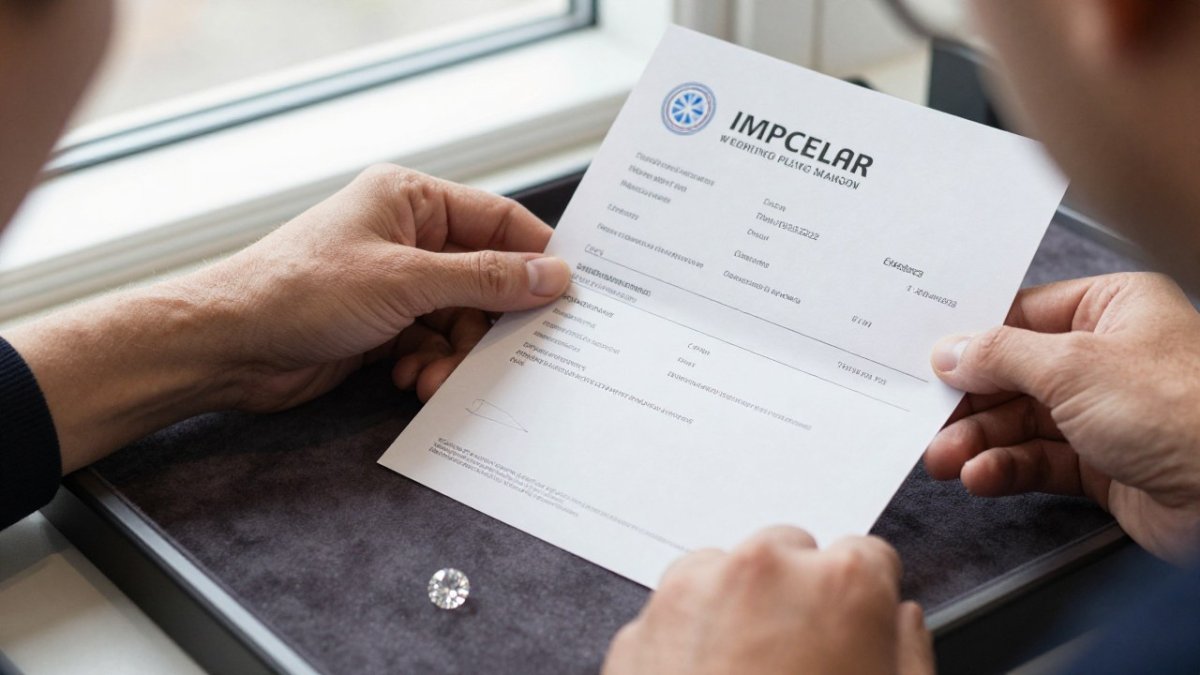
The report records the four Cs, cut, colour, clarity and carat weight, but a credible laboratory also documents proportions (table percentage, crown angle, pavilion depth), polish and symmetry grades, fluorescence, and any treatments detected. You can see the full range of analysis covered in a GIA certificate for our rings. Two diamonds with the same four Cs can differ in light performance and durability, so ask for the full report, not just the headline grades.
Check that the report number matches the number inscribed on the diamond's girdle, most reputable laboratories inscribe a unique report number, often microscopically. If the stone is set, ask the seller to confirm the inscription is visible or provide a photograph. A mismatch is a clear reason to stop and ask questions.
Watch out: a report for a similar diamond is not a guarantee for yours. Always confirm the report describes the exact stone you are buying, including its measurements and any inclusions plotted on the diagram.
Request the original report (or a verified digital copy) and cross-check it on the laboratory's own verification service before you commit.
Diamond Certificate Verification: Checking Before You Pay
Verify the certificate before you commit: ask for the report number and enter it on the laboratory's own verification service. Our buying FAQs answer common questions about the GIA certificates on the diamonds we sell. Never rely on a copy the seller sends you.
Ask whether the stone is loose or set, and whether the report describes the exact stone you are buying.
Before you pay, check the certificate against these key points from the guide.
| Check | What to do | Why it matters |
|---|---|---|
| Report number | Enter it on the laboratory's own verification service | Confirms the report is genuine |
| Source of the copy | Never rely on a copy the seller sends you | Avoids a forged or altered report |
| Loose or set | Ask whether the stone is loose or set | Determines how the report is matched |
| Exact stone | Confirm the report describes the stone you are buying | A report for a similar stone is no guarantee |
Diamond Certification Versus Valuation, and Ethical Sourcing
A certificate and a valuation serve different purposes, and confusing them can leave you without recourse if something goes wrong. A certificate, more accurately a grading report or authentication opinion, describes the item's characteristics and, for luxury goods beyond diamonds, confirms whether it is genuine. A valuation estimates worth for insurance or resale; it does not confirm authenticity, and a certificate does not guarantee a value.
A certificate is an independent opinion at a point in time, based on the evidence available. It does not guarantee provenance, ownership history, or that the item has never been altered after assessment. A certificate is only as strong as the authenticator's independence and the evidence they examined, so ask whether the provider has any financial interest in the sale; if they do, the opinion is not independent.
Arranging an in-person assessment is straightforward: bring the item, any original paperwork, and the seller's description to a recognised laboratory or independent authenticator. Use a tracked, insured service and photograph the item before sending if you submit remotely. Confirm turnaround times before you submit.
If an item is later disputed, your certificate is part of the evidence trail. Keep the original report, the seller's listing, payment records, and any correspondence. If a seller misrepresents an item, you may have routes through the retailer's complaints process, your payment provider (for card payments), and consumer protection bodies. A certificate supports your position but does not replace those routes.
Certification also says nothing about where the diamond came from. For that, read how a seller handles sourcing. Our guide to ethical diamond jewellery covers what to look for. Compare certified and non-certified diamonds before you decide which matters more to you.

FAQ's
Some of the most common Q&A's