



Are You Paying for the Setting or the Stone?

Last Updated: November 19, 2026
Quick Summary
Signs of a high quality diamond setting include a stone that sits level with no tilt, evenly spaced prongs with smooth rounded tips, and no movement when the stone is gently rocked. Clean metal-to-stone fit with no gaps and consistent polish across claws, gallery and band also signal professional workmanship.
- A well-set diamond sits square in the mount, not tilted, and stays put under light finger pressure.
- Four claws on a round stone should sit at roughly 10, 2, 4 and 8 o'clock.
- Under a 10x loupe, look for a smooth claw-to-stone transition with no file marks or gaps.
- V-shaped claws are the norm on princess and pear cuts because they protect sharp corners.
- A high price or prestigious brand is not proof of good claw work.
Table of Contents
- How to Tell If a Diamond Is Set Properly
- Signs of a Loose Diamond in a Ring
- Diamond Prong Setting Quality: What to Inspect
- Your Diamond Setting Quality Checklist
- Frequently Asked Questions
How to Tell If a Diamond Is Set Properly
A well-set diamond sits level, grips the stone evenly at every prong, and shows no movement when you rock it gently. A diamond setting is the metal structure that holds the stone, and its workmanship decides whether the diamond stays safe for decades. Four generations of jewellery workmanship point to the same handful of checks that catch most problems.
Start with the stone: it should sit square in the mount, not tilted. Run a fingertip across the prongs, they should feel smooth and rounded, never sharp or snagging.
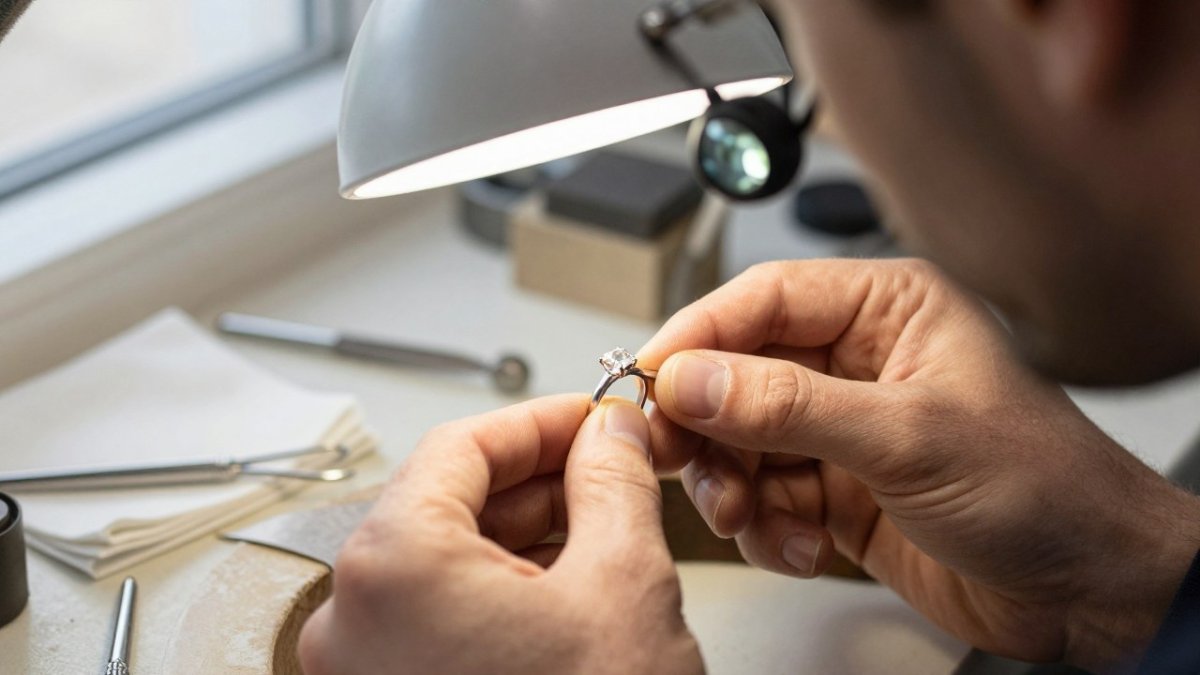
Then look at the finish. Rough edges, uneven claws or gaps between metal and stone point to rushed work. Our guide to different diamond ring settings explains what each type should look like.
Signs of a Loose Diamond in a Ring
A loose diamond rarely fails without warning. Claws, seat and gallery wear gradually, and the stone shifts by fractions of a millimetre long before it drops. Reading those early signals is the most useful setting skill a ring owner can develop.
- The stone rocks or clicks when you press it gently. The clearest signal a claw has lifted or worn back. Press lightly with a fingertip or soft eraser, never metal, and listen for a faint tick.
- Claws look worn, bent or uneven. Claw tips thin over years of daily wear, flattening from a cup to a stub.
- The diamond spins freely in its seat. A well-set round brilliant should not rotate under light finger pressure; if it turns, the seat has opened up.
- You see a dark line or shadow under the stone. This points to a gap between pavilion and seat, or trapped dirt in a space that should not exist.
- The ring snags on knitwear more than it used to. A lifted or sharpened claw catches fibres before skin, treat a new snag as an inspection prompt.
- The stone sits visibly off-centre. Look straight down: the table should be parallel to the band, and a tilt of a degree or two shows clearly from above.
Watch out: never test a suspected loose stone by shaking the ring near a sink or over a hard floor, that is exactly how it is lost. Work over a soft cloth on a table and stop wearing the ring until a jeweller has checked it.
Multi-stone rings carry extra risk because every stone needs its own secure seat, and a single loose side stone is easy to overlook. Our breakdown of multi-stone ring settings is worth reading if your ring holds more than one diamond. In Birmingham, a Jewellery Quarter jeweller can usually confirm movement in minutes with a loupe and probe, ask them to check every stone, not just the centre.
Diamond Prong Setting Quality: What to Inspect
Prong quality is where most setting problems hide. A grading report tells you about the stone; it says nothing about whether the claws were shaped, seated and polished to a professional standard.
A good claw is thick enough at the base to carry the stone's weight, shaped to cup the crown edge rather than pinch it, and polished so the tip is rounded rather than sharp. Poor claw work looks thin, flattened, unevenly spaced or over-polished to a point. Under a 10x loupe you should see a smooth transition from claw to stone, with no file marks, porosity or gap where the claw meets the girdle.
- Count the prongs and confirm even spacing. Four claws should sit at roughly 10, 2, 4 and 8 o'clock on a round stone; six should divide the circle evenly. Uneven spacing usually means a claw has been replaced or bent back.
- Look for cracks or thinning at the base of each prong. Metal fatigue shows here first, particularly on re-tipped claws.
- Feel for sharp tips that could snag. Run a fingertip, then fine knitwear, across each claw; a well-finished tip glides.
- Rock the stone gently to test for movement. Use a soft probe, not a fingernail, and watch the girdle against the seat.
- Ask when the prongs were last checked. Jewellers commonly recommend periodic checks for a daily-wear ring.
- Compare the metal finish across the setting. Claws, gallery and band should share the same polish and colour; mismatched finishing often signals an outside repair.
Prong shape matters as much as prong count. Round claws suit most brilliant cuts; V-shaped claws are the norm on princess and pear cuts because they protect the sharp corners (Complete Guide to Engagement Ring Settings: Types vs. Styles). Platinum is denser and holds its shape longer, while white gold wears faster at the tips and needs periodic rhodium re-plating.
Watch out: a high price or prestigious brand is not proof of good claw work. Judge the setting on its own terms, even spacing, clean seats, smooth tips, no gaps, and ask for the workmanship to be shown under magnification before you commit.
Prongs are the least protective setting style, which is why many buyers weigh them against alternatives. Our guide to the bezel ring setting covers the pros, cons and expert advice if you want a more enclosed option. In Birmingham, ask the jeweller to walk you through the claws under a loupe and explain how the setting will be checked at service, the answers tell you as much about the workshop as the ring itself.
Your Diamond Setting Quality Checklist
- Stone sits level with no tilt
- All prongs are even, smooth and intact
- No movement when the stone is tested
- Setting metal matches the band with no gaps
- Grading report matches the stone
- Workmanship is clean under magnification
- Aftercare and warranty terms are clear
A grading report tells you about the diamond, not the setting, so ask about both. Our engagement ring guide covers setting, certification and warranty in one place. When you are ready to compare stones, browse certified round engagement rings and see the workmanship for yourself.
| High-Quality Setting | Low-Quality Setting |
|---|---|
| Even prong spacing | Uneven or missing prongs |
| Smooth, polished tips | Sharp, snagging edges |
| Stone sits level | Stone tilts or rocks |
| Clean metal-to-stone fit | Visible gaps |
| Regular checks advised | No maintenance guidance |
A high-quality setting is the difference between a ring you wear daily and one you worry about. At Marlows Diamonds in Birmingham, our in-house workshop lets us check every setting by hand, with GIA-certified diamonds and lifetime aftercare that includes cleaning, polishing and resizing. Get started with Marlows Diamonds and wear your ring with confidence.

FAQ's
Some of the most common Q&A's